
DATACENTER AS AN APPLICATION™

The VM sees GPU hardware. STRATUM sees the fabric.

stratum gpu2

The GPU no longer has to be in the server.

STRATUM introduces a purpose-built virtual GPU hardware device that makes accelerator resources part of the virtual datacenter itself. Attach virtual STRATUM GPUs to a VM and the guest receives local-appearing PCIe GPU devices with BAR address spaces, MMIO control, DMA transport, interrupts, telemetry, and CUDA/NVML integration. Behind that device, STRATUM connects the workload to real GPU capacity available through the STRATUM Continuum (network mesh).

ALT: Appliances

A GPU that belongs to the datacenter.

Virtual hardware inside the VM. Physical acceleration across the Continuum.
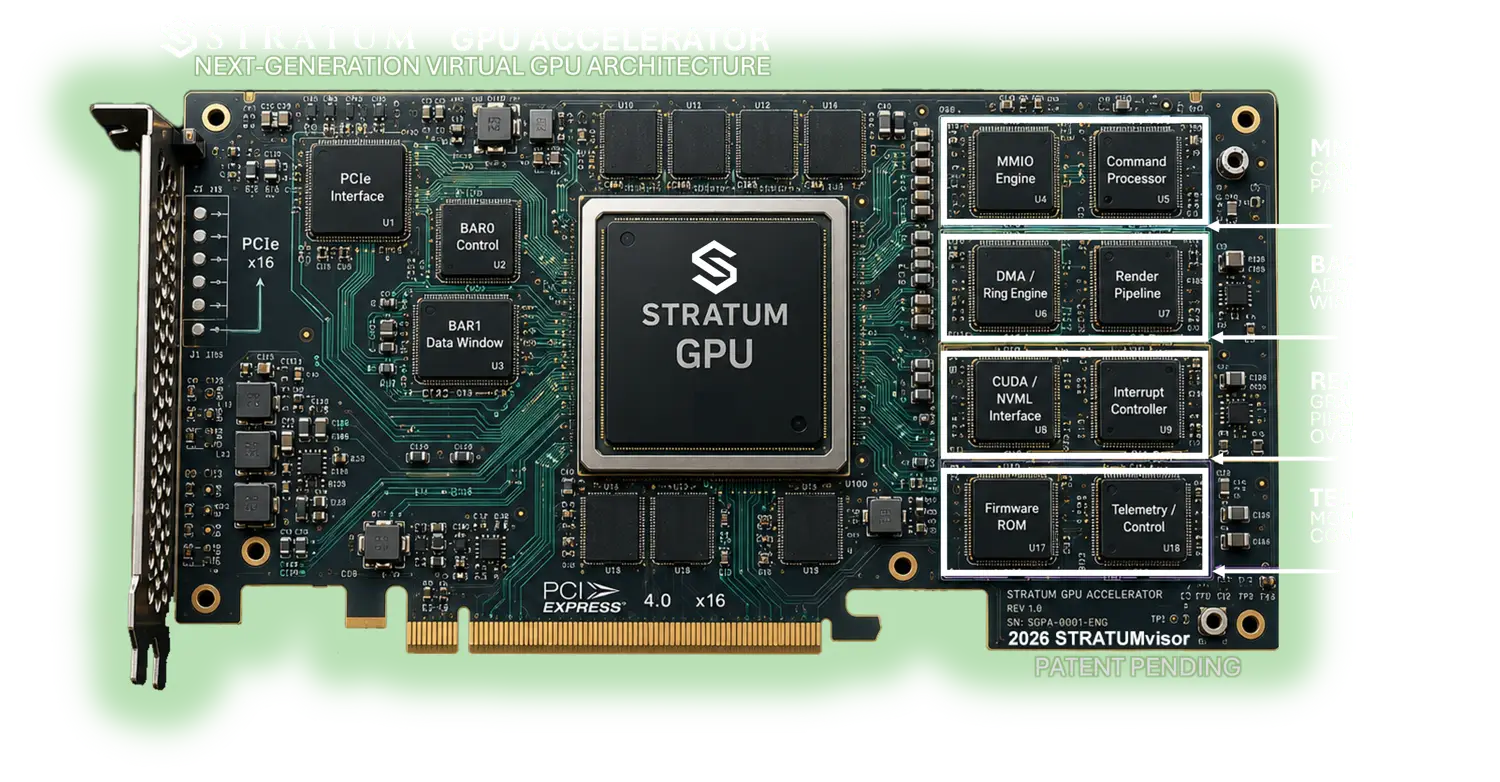
STRATUM GPU is a purpose-built virtual PCIe hardware device, not a remote GPU endpoint bolted onto a VM. The guest sees an attached accelerator with BAR address windows, MMIO control, DMA command transport, interrupts, telemetry, and CUDA/NVML integration. Behind that device, STRATUM connects the workload to physical GPU capacity through the STRATUM Continuum, allowing the accelerator relationship to become part of the virtual datacenter itself.

01 Virtual Hardware PCIe Device Virtual Hardware, Not a Remote Endpoint A purpose-built PCIe accelerator presented directly to the VM.

STRATUM GPU is not simply a GPU service exposed over a network. STRATUM presents a purpose-built virtual PCIe accelerator device directly to the guest.

The device participates in the VM's hardware model with PCIe enumeration, BAR address spaces, MMIO registers, interrupts, and device state.

The VM sees hardware. STRATUM sees the fabric.
02 Data Path CUDA + NVML Built for GPU Workloads BAR, MMIO, DMA, command rings and GPU runtime integration.

STRATUM GPU combines BAR data windows, MMIO control, command rings, DMA-oriented transport, completion handling, and interrupts into a hardware-facing path designed for accelerator traffic.

Supported CUDA and NVML operations travel through the STRATUM GPU device to the physical accelerator without requiring the application to understand the network beneath it.

Not REST calls pretending to be hardware—a virtual hardware path built for GPU operations.
03 Continuum GPU Fabric The Datacenter Becomes the GPU Backplane The physical PCIe slot no longer has to define where the accelerator lives.

Traditional GPU attachment is constrained by the chassis:

VM → Server → PCIe Slot → GPU

STRATUM introduces another model:

VM → STRATUM GPU → Continuum → GPU Resource

The accelerator can be associated with the local worker or supplied by GPU-capable infrastructure elsewhere in the STRATUM Continuum.

The GPU becomes a datacenter resource, not merely a peripheral installed in one server.

04 Operations Zero Endpoint Plumbing No GPU-Server Plumbing No GPU-server addresses or transport topology inside the workload.

Traditional remote-GPU architectures can expose another layer of infrastructure: GPU-server addresses, ports, firewall rules, client services, transport mappings, and resource endpoints.

STRATUM moves that relationship beneath the VM. The workload consumes STRATUM GPU while the platform resolves the accelerator, execution worker, transport, and Continuum relationship behind it.

Other architectures expose the GPU network. STRATUM makes it disappear into the infrastructure.
05 Datacenter as an Application Portability The GPU Relationship Travels With the Datacenter Accelerator topology becomes part of the executable infrastructure.

STRATUM can define GPU capability alongside the rest of the virtual datacenter: VMs, CPU, memory, networking, STRATUM Switch topology, storage, execution placement, identity, policy, and site relationships.

Existing Windows and Linux workloads can gain accelerator access without first being rebuilt as cloud-native applications.

Build the environment. Version it. Move it. Reconstruct it where compatible infrastructure exists.

A GPU should not be a peripheral attached to a server. It should be a resource attached to the datacenter.

Distinction

In comparison, NVIDIA vGPU uses mediated/direct virtual GPU mechanisms associated with a physical GPU, while AMD MxGPU uses SR-IOV virtual functions derived from the physical GPU. VMware Bitfusion, by contrast, historically provided remote GPU consumption using client/server software and CUDA API remoting. STRATUM GPU architecture is distinguishable from both categories. 
STRATUM GPU is an accelerator, where the architecture coves AI accelerators, FPGAs, inference devices, cryptographic accelerators, etc...

PATENT PENDING